Demetrius Wilson (Light in a Dark Mirror, Half Gallery)
Demetrius Wilson
Light in a Dark Mirror
Half Gallery
New York
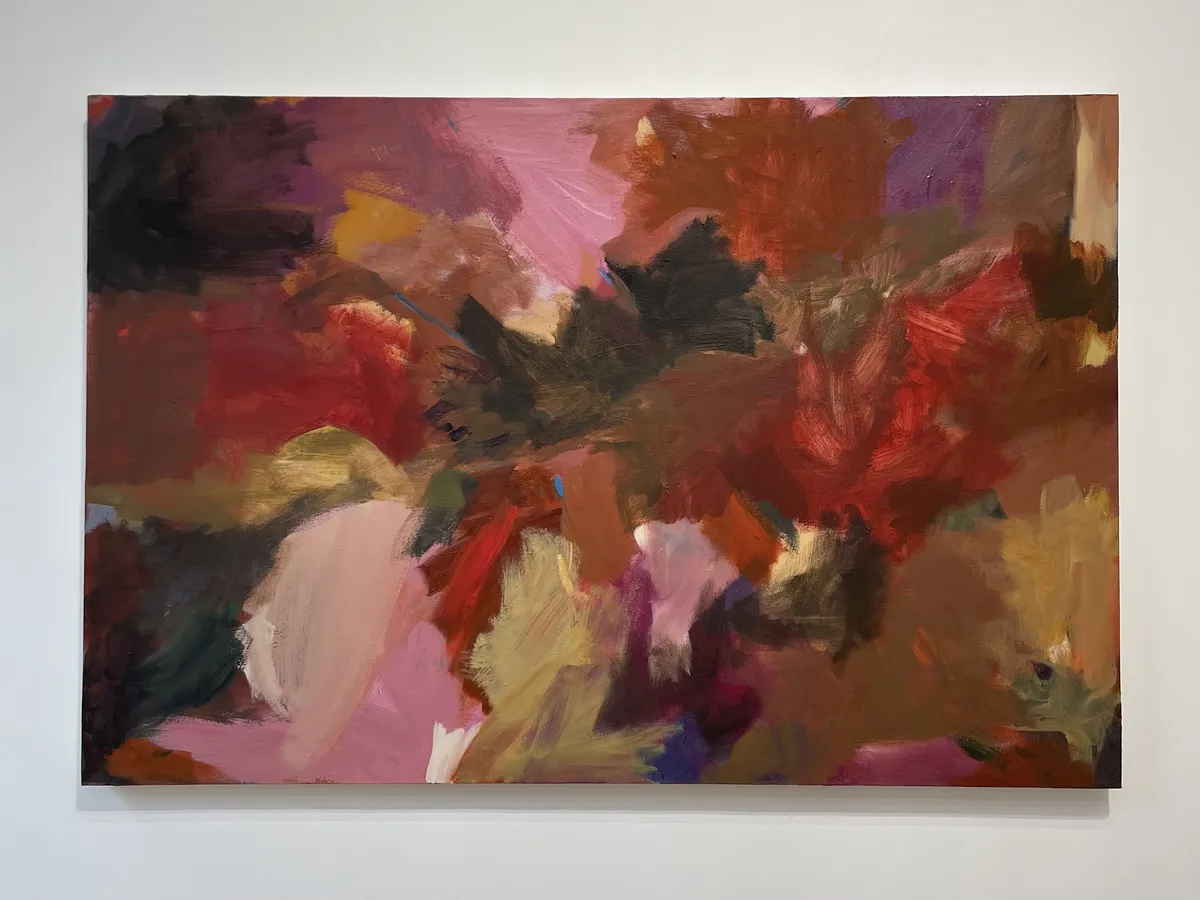
View of Consume, 2025-2026, 40x60 in.
The exhibition text
The statement behind the gallery's QR code tells us that the pieces are abstract paintings, and uses another artist to contextualize the show:
The Hunter MFA shares the late Ed Clark's opinion that "the paint is the subject", sidestepping the anthropomorphic in favor of the crepuscular.
("Anthropomorphic" means having human characteristics. "Crepuscular" means relating to twilight.)
We find that Ed Clark, who passed in 2019, also made abstract paintings, although he had been a realist painter when he arrived in Paris in the 1950s. He was quoted in 1990 as saying, "It struck me that if I paint a person--no matter how I do it--it is a lie. The truth is in the physical brushstroke and the subject of the painting is the paint itself."
The statement continues:
"We are beings born in and from darkness so it's no wonder why we find tragedy, violence and tension so attractive. But it is also in our nature to seek the light--truth, beauty, goodness," says Wilson of his fascination with that liminal state: be it emotional or actual twilight.
So, we can expect this work to draw attention not to human subjects, but to the paint itself; and more specifically, to how paint can show the relationship between light and darkness, both literally and morally.
The exhibition text also mentions "combustion", or fire, as a theme in the work, referring to "temperature" and "illumination". Fire has a big overlap with light, but we can also think about the action of burning.
The paint: Form
The works are oil on canvas, large, all at least 40 inches tall with the exception of a single painting--titled Joyous Doom--which is 16x20 inches. I wondered why just one small piece had been included in the show. Looking at it closely, I found its shapes somewhat softer due to the impression of the brush being less visible in each stroke.
In the larger paintings, you can really see the bristles. The strokes are clear and relatively similar in thickness, making it tempting to try to track exactly where the brush has been. In some places, colors show through in layers. Each area is formed from strokes pointing in many directions, which made me perceive each color as pushing its ground, negotiating its territory with its neighbors.
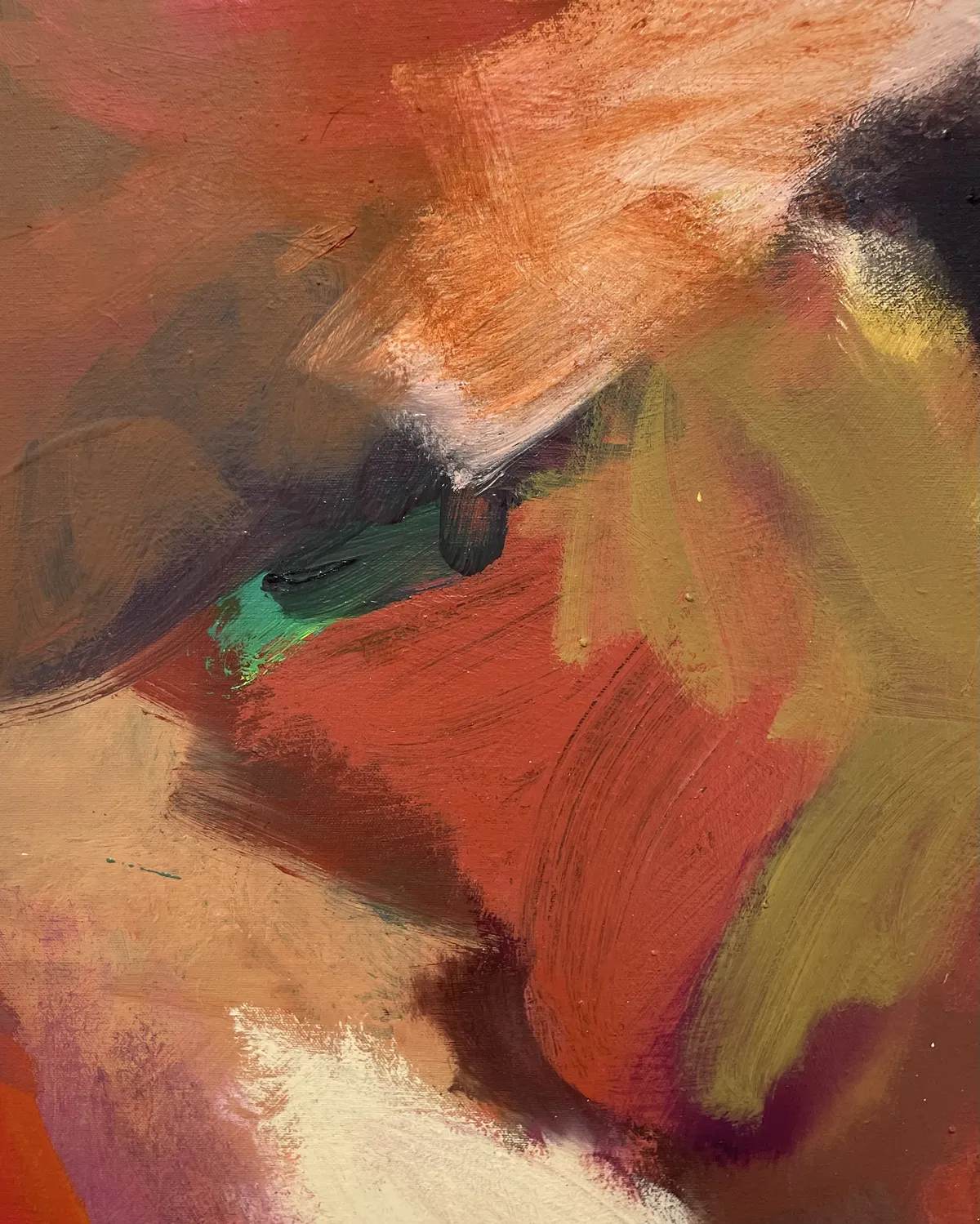
Detail of Obsessive Adoration (Thine), 2025-2026
We can think back to fire here. The crispness of the brushstrokes combined with their lively directionality recalls how clear the outline of a flame is, even as it never stays still. If we think of the visible process of the paintings as a kind of combustion, it's easy to feel like it's not finished, and that at any moment the colors could resume their consumption of the canvas.
The paint: Color
The palette of the work is earthy and often muted, but the range of colors is huge and many of them--crimsons, teals, indigos--are the kinds of rich, dark tones typically associated with jewels. This makes the color appear dark and bright at the same time, which is what we would expect based on the show text but which also feels like a small miracle. The feeling echoes the show's title: When we glimpse something shiny in a dark room, or through a lens or glass that is dirty, we register the quality of brightness, even if not much light is reaching our eyes.
In several large paintings, there are tiny flecks of a highly saturated color that does not appear much in the painting as a whole. In Obsessive Adoration (Thine), for example, tiny bits of bright yellow and blue sit on top of an otherwise ruddy, earthy composition.
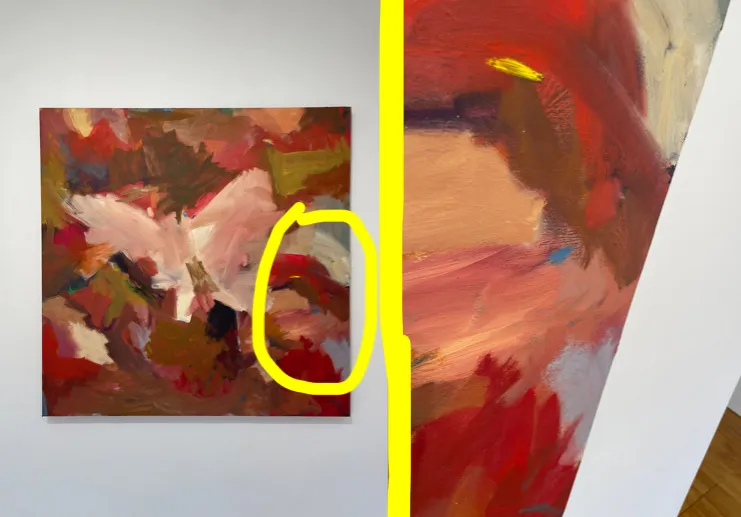
Where did these come from?
These little flashes give the viewer a reason to step close to the work. They also suggest a space outside the canvas, where something different perhaps is happening, traces of which have just floated into view.
But wait, aren't these abstract?
If these are abstract paintings, is it wrong to think about what is "happening" in (or outside of) them?
In a lot of abstract art, it's easy to name things. Here's a triangle. There's a wavy line. In these paintings, almost nothing can be named aside from colors. There are not quite shapes; there are areas, splotches, patches. Maybe because of this, while I looked at the work, my mind kept grasping at real things, like looking at clouds. In Obsessive Adoration (Thine), a butterfly. In Town that Cried, a clearing in a forest. In They're Not Okay, a mushroom, or a palm tree, or a person in a hat hunched over another figure. And was the stylistic outlier, Inevitable, with its horizontal layers, NOT a bird lying on a surface under a half moon? And was it... alive, or dead?
Besides figures, I also saw sky and ground. The yellow paint at the top of This Isn't Familiar (Famine), the largest piece in the show, is applied with brushstrokes that angle down on the rest of the composition like sunbeams breaking through clouds.
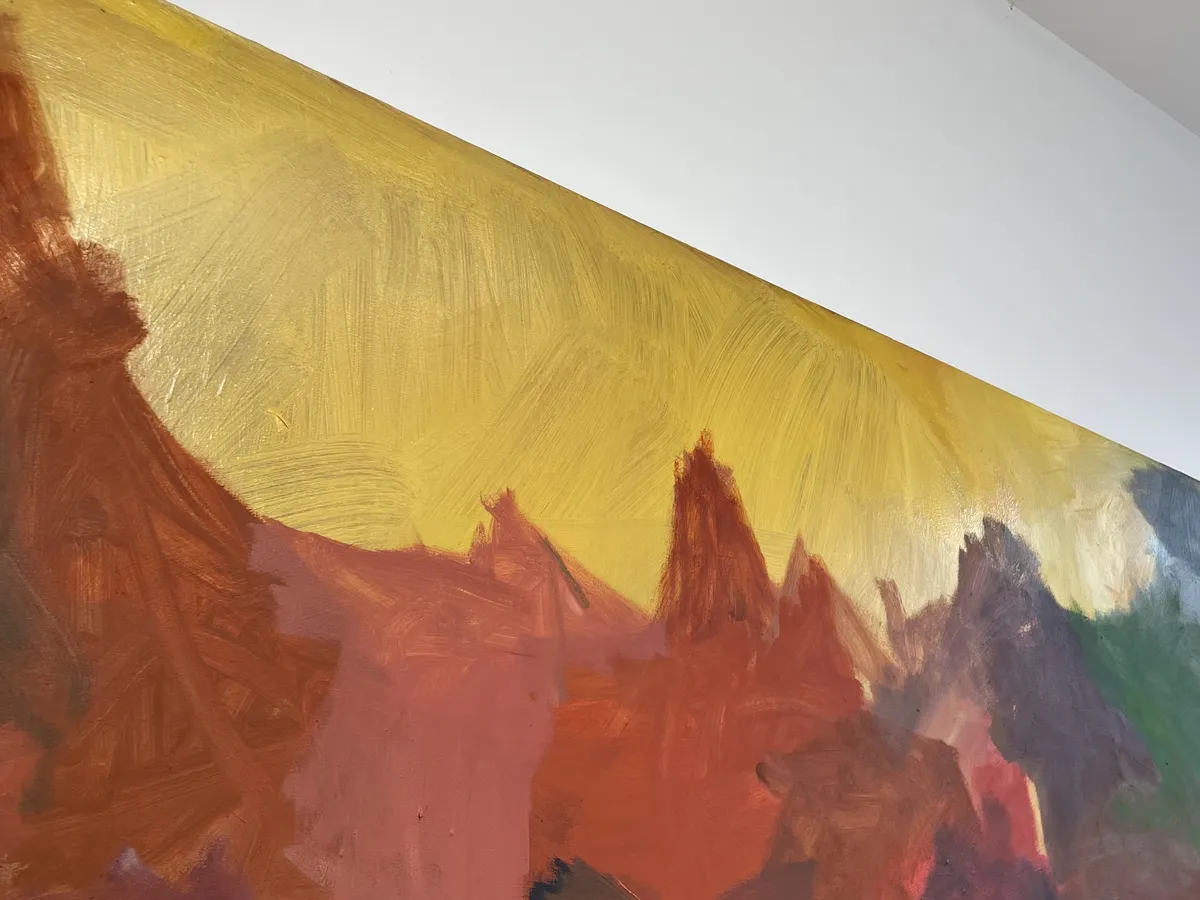
Detail of This Isn't Familiar (Famine), 2024-2026
The text on Wilson's website bio says that his paintings contain "visions of apocalypse, hunting scenes, and primal conflicts", continuing, "Figures rarely appear whole but surface as fragments--animal, human, or hybrid--emerging from the turbulence of paint." There may be some justification, then, for seeing figures in these pieces. Their names, also, invite interpretation--there is not an "Untitled" among them.
So, what are we to do with this question of how to see, and what to see? Remembering Wilson's commentary on twilight, do we see darkness and tragedy, or beauty and light? Or do we see only the paint? Making just one choice, and sticking with it 100%, feels impossible.
Final thoughts
All of the text around the exhibition points to conflict, whether physical, emotional, or stylistic. It's also present in the work: Stillness vs. movement, dark vs. light, figures vs. paint.
According to Britannica, tension in art is a controlled balance of opposites that has a dramatic or dynamic quality. The tension in these paintings is exciting. It makes you look at the finished work and ask, How will it end?
What do you see?
This show is up at Half Gallery through March 13.